Feature: Pooling
The Pooling feature provides the ability to load-balance work across a “pool” of active-active Drools-PDP hosts. This particular implementation uses a kafka topic for communication between the hosts within the pool.
- The pool is adjusted automatically, with no manual intervention when:
a new host is brought online
a host goes offline, whether gracefully or due to a failure in the host or in the network
Assumptions and Limitations
Session persistence is not required
Data may be lost when processing is moved from one host to another
The entire pool may shut down if the kafka topic becomes inaccessible
Key Points
Requests are received on a common kafka topic
Uses a single, kafka topic for all inter-host communication
- Allocates buckets to each host
Requests are assigned to buckets based on their respective “request IDs”
No session persistence
No objects copied between hosts
Requires feature(s): distributed-locking
Example Scenario
Incoming message is received on a topic — all hosts are listening, but only one random host receives the message
Decode message to determine “request ID” key (message-specific operation)
Hash request ID to determine the bucket number
Look up host associated with hash bucket (most likely remote)
Publish “forward” message to internal topic, including remote host, bucket number, topic information, and message body
Remote host verifies ownership of bucket, and routes the message to its own rule engine for processing
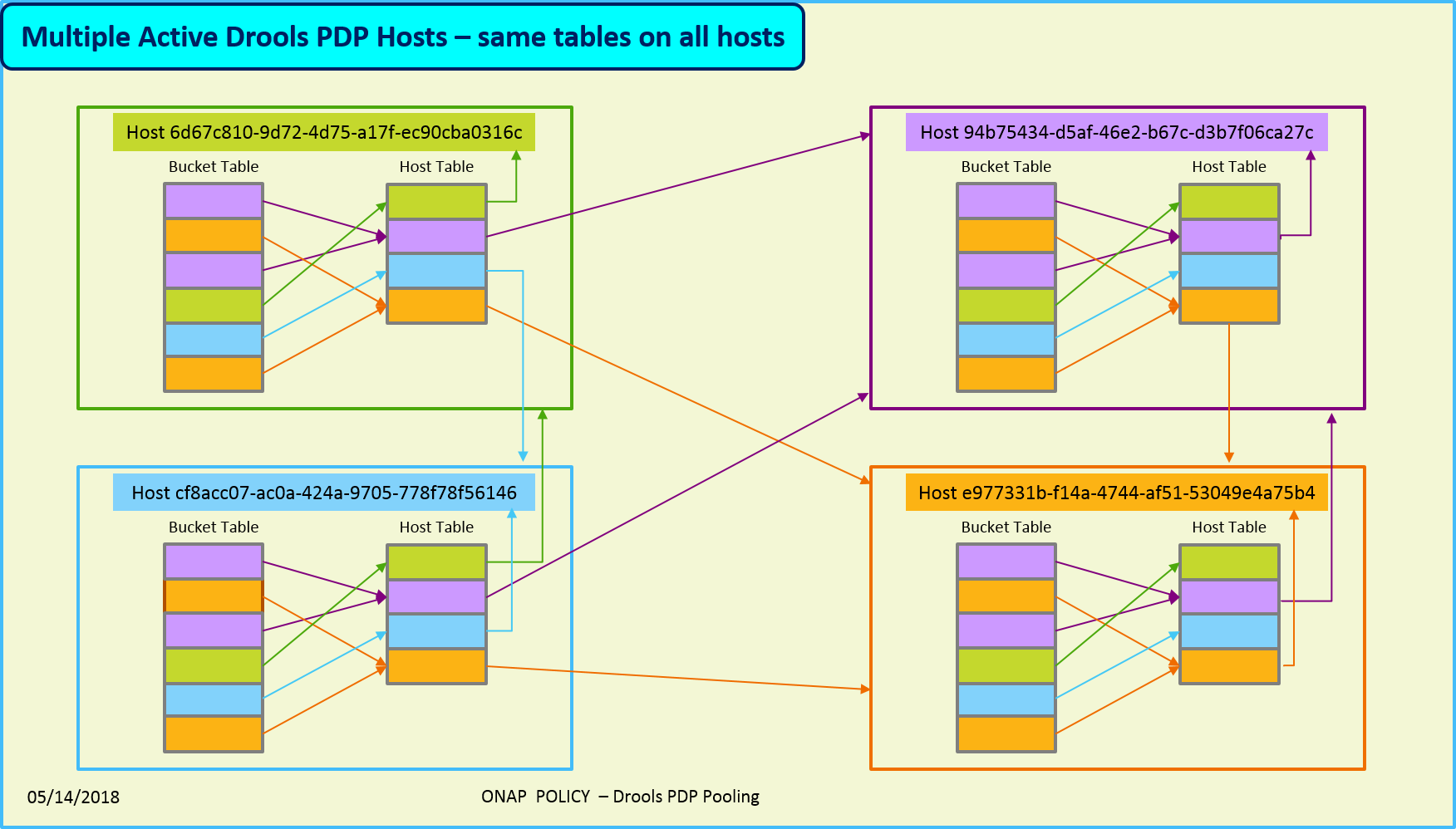
The figure below shows several different hosts in a pool. Each host has a copy of the bucket assignments, which specifies which buckets are assigned to which hosts. Incoming requests are mapped to a bucket, and a bucket is mapped to a host, to which the request is routed. The host table includes an entry for each active host in the pool, to which one or more buckets are mapped.
Bucket Reassignment
When a host goes up or down, buckets are rebalanced
Attempts to maintain an even distribution
Leaves buckets with their current owner, where possible
Takes a few buckets from each host to assign to new hosts
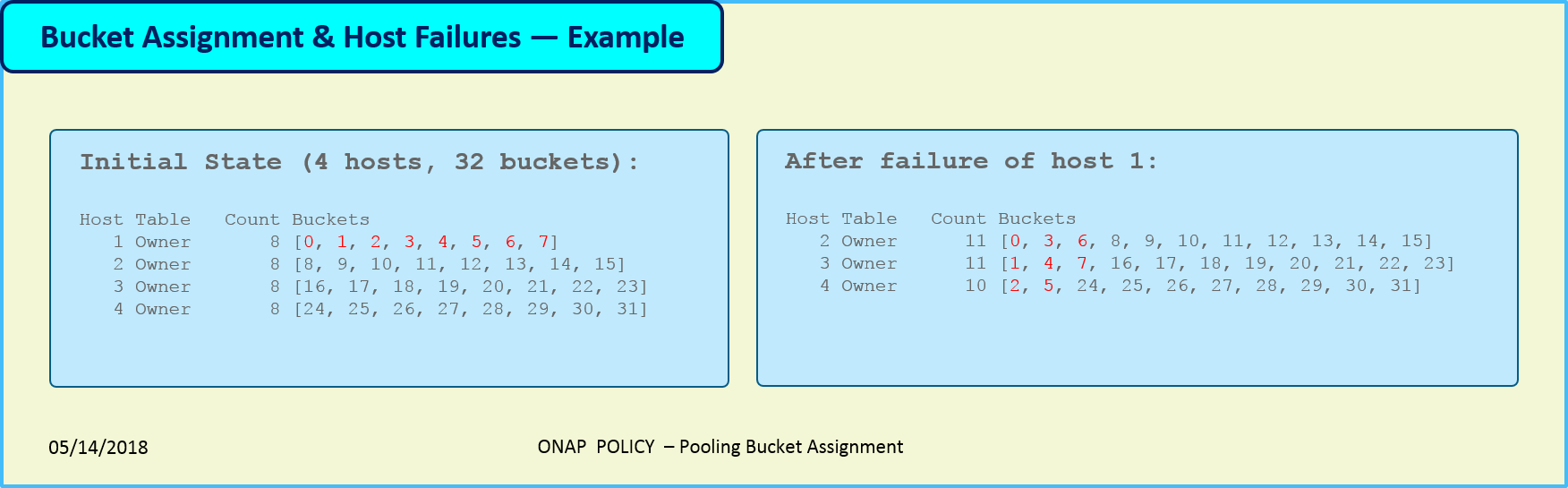
For example, in the diagram below, the left side shows how 32 buckets might be assigned among four different hosts. When the first host fails, the buckets from host 1 would be reassigned among the remaining hosts, similar to what is shown on the right side of the diagram. Any requests that were being processed by host 1 will be lost and must be restarted. However, the buckets that had already been assigned to the remaining hosts are unchanged, thus requests associated with those buckets are not impacted by the loss of host 1.
Usage
For pooling to be enabled, the distributed-locking feature must be also be enabled.
Enable Feature Poolingpolicy stop features enable distributed-locking features enable pooling-messagesThe configuration is located at:
$POLICY_HOME/config/feature-pooling-messages.properties
Start the PDP-D using poolingpolicy startDisable the pooling featurepolicy stop features disable pooling-messages policy start
End of Document